.jpg/:/rs=h:121,cg:true,m/qt=q:95)
.jpg/:/rs=h:104,cg:true,m/qt=q:95)
Multiplicative Thinking Intervention Program
Multiplicative Thinking Intervention Program for Grades 3–5
Most teachers have a handful of students who are still working out multiplication facts by counting up — tapping out threes, reconstructing sevens from scratch, starting over with every new problem. It's not a effort issue. It's a reasoning gap: somewhere along the way, these students never built a conceptual understanding of what multiplication actually means. And without that foundation, fact fluency stays out of reach no matter how many times tables they practice.
The Multiplicative Thinking Intervention Program gives you a research-based, diagnostic-first system to find exactly where that gap is and close it — moving students from additive counting strategies toward genuine multiplicative reasoning that holds up as math gets harder. Watch the free 2-hour 45-minute training and walk away with 50+ ready-to-use resources the same day.
Start With the Diagnostic Assessment

Why Multiplicative Thinking Is the Turning Point
Students who don't move beyond additive thinking by Grade 6 consistently hit a ceiling in secondary math. Research by Professor Dianne Siemon and the Scaffolding Numeracy in the Middle Years project found that this gap — between students who understand multiplication conceptually and those who are still skip-counting — is one of the strongest predictors of long-term math difficulty. The Multiplicative Thinking Intervention Program exists specifically to close it, before it becomes permanent.
Before any instruction begins, every student is assessed to identify exactly where their understanding breaks down — not just whether they got the answer right, but how they got there.
The assessment evaluates students across five problem structures: equal groups, measurement division, partitive division, rate, and multiplicative comparison. It observes whether a student is still using perceptual counting, skip counting, or additive strategies — and maps them onto the framework accordingly.
Key feature: Any student scoring at or below 65% on a problem structure is classified as foundational for that area, ensuring teachers address the real gap rather than the surface-level symptom.

What You Get — Free After the Training
Watch the free 2-hour 45-minute training and receive immediate access to:
- Multiplicative Thinking Diagnostic Assessment
- Multiplicative Thinking Framework (Grades 3–5)
- Leveled Activities Guide
- Skip counting Book
- Immersion with Facts Program (based on Jo Boaler's Fluency Without Fear research)
- 30+ visual teaching models (Printable)
- Introductory access to the resource e-library: Developing Multiplicative Thinking Workbook, Multiplicative Thinking Independent Assignment Workbook.
Additional lesson libraries are available for purchase. Everything above is free.
Take a look at the Immersion with Facts sample below! To see everything the program has to offer, head over to the Immersion with Facts page.

The Multiplicative Thinking Framework
Once assessed, each student is placed on a developmental roadmap with clear instructional starting points and a defined path forward.
Levels AA & A — Foundational
Students rely on physical counting and need to see all items in a set to calculate a total. Instruction focuses on building the concept of equal groups before any formal multiplication is introduced.
Levels B & C — Transitional
Students begin using skip counting and start to distinguish between the number of groups and the size of groups. Instruction moves toward recognizing multiplication and division as a single relationship.
Level D — Proficient
Students trust the count. They use the inverse relationship between multiplication and division and can derive unknown facts from known ones. Instruction moves into multi-digit work, expanded notation, and place value division.
How Instruction Works — The CRA Model
Every lesson in this program follows the Concrete–Representational–Abstract sequence, one of the most evidence-supported instructional models for students with math difficulties.
Concrete: Students work with physical manipulatives — counters, beads, real objects — to build a tactile understanding of equal groups before any symbols are introduced.
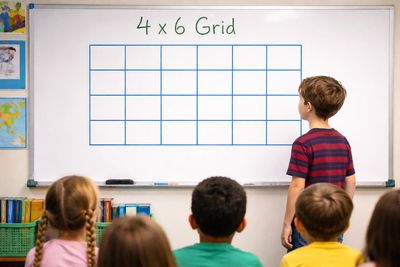
Representational: Arrays and area models replace physical objects. A key strategy here is the partial array — part of the grid is covered, requiring students to mentally visualize the hidden units rather than count what they can see. This shift from counting to reasoning is where real multiplicative thinking begins.
Abstract: Once visual logic is established, students move to formal notation — expanded notation, place value division, and eventually standard algorithms — built on genuine understanding rather than memorization.