.jpg/:/rs=h:121,cg:true,m/qt=q:95)
.jpg/:/rs=h:104,cg:true,m/qt=q:95)
Word Problem Intervention Program (K–5)
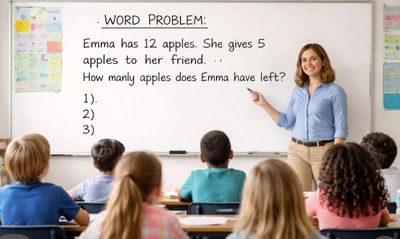
Explicit, Schema-Based Word Problem Intervention for Grades K–5
Word problems are one of the hardest things to teach, and most programs respond by giving students a checklist instead of a framework. Keyword strategies, highlight-and-circle routines, surface-level tricks that collapse the moment the language gets more complex.
Every word problem has a DNA. Schema-based instruction teaches students to read it. Once they can see the underlying structure of a problem, not just the words on the surface, they stop guessing and start thinking. The language can change. The numbers can change. The schema doesn't.
The Word Problem Intervention Program is a free K–5 intervention built around that framework. Watch the free training and walk away with everything you need.
How Does the Word Problem Intervention Program Work?

What Does the Research Say About Schema-Based Instruction?
Rather than seeing a wall of text, students learn to look for structure. Most early word problems follow a small number of predictable patterns. Change problems involve a starting amount that increases or decreases over time. Part part whole problems combine two groups to make a total. Comparison problems focus on the difference between a larger amount and a smaller amount. When students learn to recognize these schema structures, the problem becomes easier to organize and the equation becomes clearer.
The evidence base for SBI is deep and consistent. A meta-analysis of 21 studies involving more than 3,400 elementary school students found an overall effect size of 1.57 for immediate problem-solving performance and 1.09 for transfer — meaning students didn't just improve on practiced problem types, they applied their learning to new and unfamiliar problems as well. These are large effects by any research standard. A broader systematic review further confirmed that structured word problem-solving interventions produced a strong positive average effect across elementary school students. Across grade levels and ability groups, the pattern holds: students who are taught to recognize problem structure outperform those who receive traditional instruction, and they do so consistently.
The Problem with Keyword Strategies
The research is equally clear about what doesn't work. Studies have consistently found that keyword-based approaches fail to develop the conceptual understanding students need to reason through novel problems — and as word problems grow more complex, that gap becomes more consequential. When language doesn't follow predictable patterns, students who have been taught to hunt for clue words are left without a reliable strategy. Research comparing SBI directly to general strategy instruction found that SBI students significantly outperformed their peers on both immediate and delayed posttests as well as transfer tests — the kinds of problems students encounter on state assessments, where surface-level language cues offer little help.
Alignment with What Works Clearinghouse
The problem solving strategy reflects the instructional recommendations outlined in the What Works Clearinghouse practice guide for assisting students struggling with mathematics. Specifically, our framework addresses three of the guide's core recommendations: teaching students to use a consistent set of steps to monitor their own problem-solving process, using visual representations to connect numbers to their real-world meaning, and building students' ability to recognize structural similarities and schemas across different problem types. The WWC rates these recommendations with strong or moderate evidence, placing them among the most reliable practices available for math intervention.
The Bottom Line
The evidence points clearly in one direction: students who learn to think about the structure of a problem — not just the words in it — become more accurate, more confident, and more independent mathematical thinkers. WPIP is built to deliver exactly that.
What Do Teachers Get for Free with WPIP?
After completing the free two-hour training you will have immediate access to the diagnostic assessment, schema posters for Part-Part-Total, the Developing Schema Resource for Part-Part-Total, the instructional sequence document, a prompting guide for all three schema types, four read-alouds covering the problem-solving strategy and each schema, and a unit from each of the four workbooks.
Visual Schematics and Diagram Tools
Students draw diagrams and models to help them interpret problems, and WPIP takes this further by using visual organizers to bridge the gap between the word problem and the equation. Through models and number lines, students can work through the problem and see the mathematical relationships before they begin calculating. This representational step helps make the problem structure visible and concrete, which can be especially supportive for students who find it challenging to keep track of that structure while also working through the math.
Targeted Support for Tier 2 and Tier 3 Intervention
The Word Problem Intervention Program is built for seamless integration into any school's intervention block. Diagnostic placement tools identify whether a student's struggle is rooted in computation or comprehension — a distinction that completely changes the instructional response. From there, explicit I Do, We Do, You Do modeling sequences build student independence gradually, and visual scaffolds are faded as students demonstrate mastery of each schema type. The result is a program that meets students exactly where they are and moves them forward systematically.
How Does WPIP Fit Into an MTSS or RTI Framework?
WPIP is designed to align with any Multi-Tiered System of Support. The diagnostic assessment identifies student needs at the comprehension and computation level, the leveled problem sets support differentiated instruction across Tier 1, Tier 2, and Tier 3, and the built-in progress monitoring tracks mastery of specific schema types over time — giving teachers the data they need for RTI documentation, IEP goals, and team meetings.
Explore All Four Intervention Programs →
Looking for additional programs? View our full curriculum store →
Frequently Asked Questions
Is the Word Problem Intervention Program free?
Yes. The core program is completely free after completing a two-hour online training. You walk away with the Addition and Subtraction Word Problem Assessment, four schema read-alouds, a prompting guide for all schema types, introductory access to the schema posters, introductory access to the Developing Schema resource, and one unit from each of the four workbooks. Additional workbooks and full lesson libraries are available for purchase, but everything listed above costs nothing. No login, subscription, or credit card is required.
What grades is WPIP designed for?
WPIP is designed for Kindergarten through Grade 5. The program spans additive reasoning schemas — Part-Part-Total, Change, and Compare — through multiplicative schemas including Equal Groups and Multiplicative Comparison, making it applicable across the full elementary range and appropriate for students working below grade level in middle school.
What is schema-based instruction and why does it work?
Schema-based instruction teaches students to recognize the underlying structure of a word problem before they attempt to solve it. Rather than hunting for keywords that often mislead, students learn to identify a small number of predictable problem types and use that structure to build an equation. A meta-analysis of 21 studies with more than 3,400 elementary students found an effect size of 1.57 for immediate problem-solving performance — one of the strongest effect sizes in mathematics intervention research.
How is WPIP different from keyword strategies like CUBES?
Keyword strategies teach students to circle numbers and underline words — but when the language shifts or the problem structure becomes more complex, those strategies collapse. WPIP replaces surface-level word hunting with a cognitive framework for understanding problem structure. Students who learn to think about what type of problem they are reading become more accurate, more independent, and better equipped for the kinds of multi-step problems they encounter on state assessments.
How does WPIP fit into a Tier 2 or Tier 3 MTSS setting?
The diagnostic assessment identifies whether a student's struggle is rooted in comprehension of problem structure or in computation — a distinction that completely changes the instructional response. From there, explicit modeling sequences and visual scaffolds support Tier 2 small group instruction and Tier 3 intensive intervention. Built-in progress monitoring tracks mastery by schema type, giving teachers the data they need for RTI documentation, IEP goals, and team meetings.
Does WPIP work for students with learning disabilities or IEPs?
Yes. The explicit, structured nature of schema-based instruction is particularly effective for students with learning disabilities in mathematics. The visual organizers reduce working memory load, the predictable instructional sequence supports students who need consistency, and the discrete skill tracking built into the diagnostic assessment generates the specific, measurable data needed for IEP goal writing and progress monitoring documentation.
Research Foundation
The Word Problem Intervention Program is grounded in decades of peer-reviewed research on schema-based instruction, mathematical language, and word problem intervention. The following studies inform the program's diagnostic approach, instructional sequence, and emphasis on problem structure over keyword strategies.
Schema-Based Instruction
Jitendra, A. K., & Star, J. R. (2011). Meeting the needs of students with learning disabilities in inclusive mathematics classrooms. Theory Into Practice, 50(1), 10–18. — Establishes schema-based instruction as an evidence-based practice for students with math learning difficulties, demonstrating significant gains in problem-solving accuracy.
Effect Sizes for Schema-Based Intervention
Jitendra, A. K., et al. (2018). Mathematical word problem solving instruction for students with learning disabilities. Review of Educational Research, 88(4), 429–478. — Meta-analysis of 21 studies with over 3,400 students reporting an overall effect size of 1.57 for immediate performance and 1.09 for transfer to new problem types.
Failure of Keyword Strategies
Boaler, J., & Humphreys, C. (2005). Connecting Mathematical Ideas. Heinemann. — Documents how keyword-based approaches develop brittle, surface-level strategies that fail when problem language becomes complex or unconventional.
Mathematical Language and Vocabulary
Powell, S. R., & Driver, M. K. (2015). The influence of mathematics vocabulary instruction on the mathematics performance of students. Learning Disability Quarterly, 38(4), 195–207. — Demonstrates the significant relationship between mathematical vocabulary knowledge and word problem performance, supporting WPIP's integrated language component.
Visual Representations in Problem Solving
Gersten, R., et al. (2009). Assisting students struggling with mathematics: Response to intervention for elementary and middle schools. IES Practice Guide. — Recommends the use of visual representations and structured schemas as a Tier 2 and Tier 3 intervention practice with strong evidence support.
Alignment with What Works Clearinghouse
Institute of Education Sciences. (2021). Assisting Students Struggling with Mathematics: Intervention in the Elementary Grades. WWC Practice Guide. — Rates schema-based instruction and visual representation strategies with strong to moderate evidence, placing them among the most reliable practices available for math word problem intervention.