.jpg/:/rs=h:121,cg:true,m/qt=q:95)
.jpg/:/rs=h:104,cg:true,m/qt=q:95)
Place Value Free Math Games
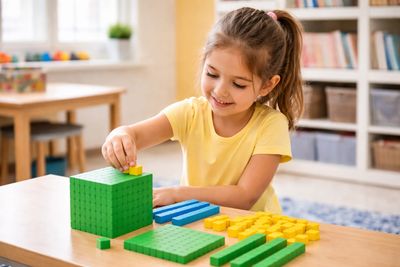
Understanding and Developing Place Value, not Memorizing Digit Places
Place value is not a topic in mathematics — it is the structural foundation that makes our entire number system work. Students who understand place value can compose and decompose numbers flexibly, reason about magnitude, regroup with meaning rather than procedure, and make sense of multiplication and division at a conceptual level. Students who do not understand it can follow rules and get right answers for a while — until the rules stop working and the gaps become impossible to ignore.
The four interactive tools on this page are designed to build place value understanding the way research says it should be built — starting with concrete base-ten models, moving through visual representations, and progressing toward abstract digit-based reasoning. Each tool targets a different stage of that progression, and together they provide a complete CRA sequence for place value instruction from Kindergarten through Grade 5.
If you are looking for a more structured approach, the Primary Numeracy Intervention Program is a free K–3 math intervention that includes a diagnostic assessment, leveled activity guides, workbooks, and over 100 ready to use resources — all built around the same foundational place value skills targeted on this page.
Place Value Explorer
Place Value Explorer
Place Value Explorer

An interactive teaching tool where students build numbers up to 9,999 using virtual base-10 blocks — thousands cubes, hundreds flats, tens rods, and ones units. Reveal color-coded arrow cards for each place value, then watch them slide together to show how the number is made. Perfect for whole-class instruction and guided discovery.
Place Value Builder
Place Value Explorer
Place Value Explorer
A game-based activity where a target number is displayed and students must build it using the correct base-10 blocks. With three levels of difficulty — up to 100, 1,000, or 10,000 — and immediate feedback after every answer, Place Value Builder makes practicing place value engaging and hands-on across 10 rounds of play.
Place Value Challenge
Place Value Challenge
Place Value Challenge
A digit-only abstract thinking game with two modes. In Largest or Smallest, students arrange random digits to make the biggest or smallest number possible — with one extra digit to leave out. In In Between, students build a number that sits between two given values. A great next step once students are ready to move beyond blocks and into flexible number reasoning.
Flip Counter
Place Value Challenge
Place Value Challenge
A dynamic skip-counting tool where large digit cards animate as the count changes. Count up or down in steps of 1, 10, 100, 1,000, or 10,000. In Free Play mode it's an open counting tool for the whole class. In Prompt Mode, students build a starting number and then answer a chain of challenges — what is 300 more? what is 1,000 less? — developing mental arithmetic fluency across all place values.